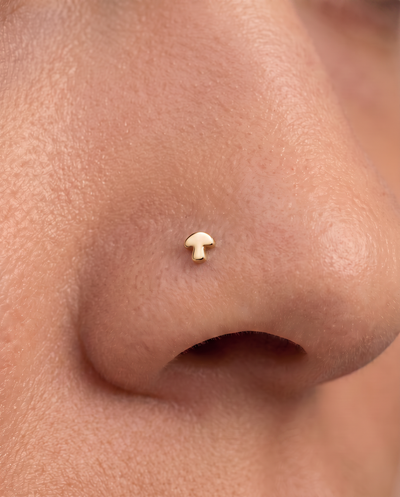
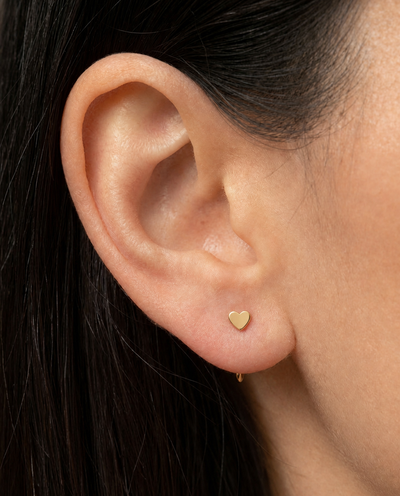
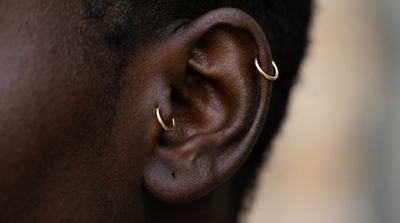
New 14ct Solid Gold Piercing Hoop


The Ultimate Guide to Choosing Your Perfect 14K Gold Seamless Nose Ring

- Know two numbers before you buy: your gauge (wire thickness — usually 20G in the UK) and your inner diameter (ring size — measured from piercing hole to the bottom edge of your nostril)
- 14K solid gold is the ideal karat for nose rings: enough gold (58.3%) for biocompatibility and rich colour, enough structural alloy for durability in thin-gauge wire
- Seamless hoops are the most comfortable style for healed nostril piercings — no clasps, no ball ends, no sharp edges inside the channel
- Piercing placement matters: a higher piercing needs a larger diameter. This is the number-one reason people order the wrong size
- Always check that the seller measures by inner diameter — some list outer diameter, which makes rings appear 1–2mm larger than they actually are
Why 14K solid gold for your nose ring?
You search “gold nose ring” online and find options from £3 to £60 — all claiming to be gold. That price range is not random. It reflects a fundamental difference in what the ring is actually made of, and that difference directly affects your skin, your piercing, and how long the ring lasts.
There are three types of “gold” nose rings on the market. Only one is gold all the way through:
14K Solid Gold
- 58.3% pure gold throughout the entire ring — no base metal core
- Nickel-free alloy (palladium, silver, copper) — safe for sensitive skin
- Never tarnishes, never flakes, never exposes hidden irritants
- Retains material value for decades — can be resold or recycled
- The only gold option endorsed by the Association of Professional Piercers (APP) for body jewellery
Gold-Plated & Gold-Filled
- Plated: A thin gold coating (0.5–5 microns) electroplated over brass or steel. Wears off in weeks inside a piercing
- Filled: A thicker gold layer mechanically bonded to a brass core — lasts longer than plating but still exposes base metal over time
- Base metal in both typically contains nickel, the most common contact allergen
- Causes green discolouration, irritation bumps, and allergic reactions when coating wears
- Needs frequent replacement — costs more long-term than solid gold
Why 14K specifically — not 9K, 18K, or 24K?
Karat measures the proportion of pure gold in an alloy. 24K is 100% pure gold — beautiful, but far too soft for jewellery wire. It would bend out of shape inside your nostril within days. The opposite extreme, 9K gold (37.5% gold, 62.5% alloy), is harder but contains so much alloy metal that the risk of skin reactions increases, and the gold colour is noticeably paler.
14K hits the ideal balance for body jewellery. At 58.3% pure gold, it has enough gold content for rich colour and excellent biocompatibility, while the structural alloy metals (palladium, silver, copper — no nickel) give the wire enough strength to hold its shape in fine gauges like 20G and 22G. This is why the APP and professional piercers worldwide recommend 14K as the minimum karat for body jewellery.
What makes a nose ring “seamless”?
A seamless ring (also called a seam ring or continuous ring) is a single piece of wire bent into a circle. There is no clasp, hinge, bead, or removable segment. The two ends of the wire are precision-cut at matching angles so they press together to form a nearly invisible join. You open the ring by gently twisting the ends apart (not pulling them), slide it through your piercing, and twist closed.
Why seamless is best for nose piercings
Comfort: The interior of the ring is a smooth, uninterrupted circle of wire. There is no ball, clasp, or hinge pressing against the inside of your nostril. Nothing catches on towels, masks, or pillowcases while you sleep.
Aesthetics: From the outside, a seamless hoop looks like a clean, minimal circle of gold hugging your nostril. No hardware is visible. It is the most refined, understated hoop style available.
Hygiene: With no crevices around a clasp or ball, there are fewer places for bacteria, dead skin, and oils to accumulate. Saline spray reaches every surface equally during cleaning.
Seamless vs clicker vs segment ring
Seamless (seam ring): No separate parts. The wire itself twists open and closed. Simplest design, most comfortable for nostrils, but requires careful handling to avoid distorting the circle shape. Not ideal if you change jewellery frequently, as repeated bending can eventually warp the ring.
Clicker: A hinged closure that snaps shut with an audible click. Easier to insert and remove than a seamless ring, but the hinge mechanism sits inside the piercing and can feel bulky in nostril piercings. Better suited to septum and daith piercings where there is more room.
Segment ring: A removable straight piece clicks into a gap in the hoop. When closed, it looks seamless. More secure than a true seamless ring but the segment piece can be fiddly to remove and is easy to drop.
Choosing your gauge (wire thickness)
Gauge refers to the thickness of the wire that sits inside your piercing channel. It uses the American Wire Gauge (AWG) system, where a higher number means thinner wire — this is counterintuitive, so pay attention:
| Gauge | Thickness | Common use | Notes |
|---|---|---|---|
| 16G | 1.2mm | Septum, daith, conch | Too thick for most nostril piercings |
| 18G | 1.0mm | Some nostril piercings (US standard) | Common in the US; slightly thicker than UK standard |
| 20G UK Standard | 0.8mm | Most nostril piercings in the UK | The standard gauge used by UK piercers for nostril piercings |
| 22G | 0.6mm | Very delicate / thin look | Fine wire — may migrate in some piercings over time |
How to find your gauge
If you were pierced by a professional in the UK, you are almost certainly 20G. If you were pierced in the US, you may be 18G. If you are unsure, visit your piercer — they can measure it in seconds using a gauge wheel. It is a free, 30-second check that prevents an expensive ordering mistake.
Why gauge accuracy matters: A ring that is too thick will not fit through the hole. A ring that is too thin will sit loosely, wobble, and create friction inside the channel — which can cause irritation bumps. Your gauge and your ring must match exactly.
Does gauge affect how thick the ring looks?
Yes, but not only because of the actual wire thickness. Gold appears visually thicker than titanium at the same gauge, because gold has higher lustre and reflectivity. A 20G gold hoop will look slightly more substantial than a 20G titanium hoop, even though they are the same wire diameter. This is purely an aesthetic effect, but it is worth knowing if you are switching from titanium to gold for the first time.
Choosing your diameter (ring size)
Diameter is the measurement across the inside of the hoop — from one inner edge to the opposite inner edge. This single number determines whether the ring sits snugly against your nostril or hangs below it.
How piercing placement affects your diameter
This is the factor most buying guides miss, and it is the number-one reason people order the wrong size. The diameter you need has nothing to do with the size of your nose. It depends entirely on where your piercing sits on your nostril:
Low piercing (near the bottom curve of your nostril): You need a smaller diameter — typically 6mm or 7mm. The ring only needs to travel a short distance from piercing hole to nostril edge.
High piercing (higher up on the nostril, toward the bridge): You need a larger diameter — 9mm or even 10mm — because the ring must curve a longer distance to reach the bottom of your nostril.
How to measure your diameter at home
Method 1 (paper strip): Cut a narrow strip of paper. Hold one end at the bottom edge of your nostril. Bring the strip up and over, threading it through the piercing hole. Mark where the paper exits the piercing hole. Remove the strip, flatten it, and measure the distance between the nostril edge and your mark. This measurement is your minimum inner diameter. Add 1mm if you prefer a slightly looser fit.
Method 2 (measure your current ring): If you already have a ring that fits well, lay it flat on a ruler and measure from one inner edge to the opposite inner edge. This gives you your known inner diameter.
When in doubt, go smaller. A slightly snug ring looks elegant and intentional. A slightly too-large ring droops below the nostril, catches on things, and creates leverage that pulls on the piercing channel.
Choosing your gold colour
14K solid gold is available in three colours. All three contain the same 58.3% pure gold — the difference is in the alloy metals mixed alongside it:
| Colour | Alloy metals | Look | Best suits |
|---|---|---|---|
| Yellow gold Classic | Silver + copper | Traditional warm gold | Warm, olive, and medium skin tones |
| Rose gold | Higher copper ratio | Warm pinkish-gold | Fair, cool, and neutral skin tones |
| White gold Check alloy | Palladium or nickel | Cool silvery-white | Cool skin tones, silver jewellery wearers |
How to insert a 14K gold seamless nose ring
Inserting a seamless ring is simple once you understand the correct technique, but there is one critical rule: twist, never pull.
Wash your hands
Use antibacterial soap and warm water. Dry with a clean paper towel — not a fabric towel.
Find the seam
Look closely at the ring to locate where the two ends meet. Run your fingernail gently around the ring — you will feel a slight catch at the join.
Twist open — do not pull apart
Hold each side of the seam between thumb and forefinger. Push one end away from you while pulling the other toward you, creating a twist. Open just enough to slide the wire through — about 2–3mm. Wearing nitrile gloves gives a much better grip.
Slide through the piercing
Insert one end into the outside of your piercing hole. Guide it through slowly. If you feel resistance, apply a tiny drop of sterile saline to lubricate — never force.
Twist closed and align
Once through, reverse the twist to close the ring. Run your fingernail over the join — if you feel a catch or a gap, twist slightly more until the ends sit perfectly flush.
Rotate and clean
Gently rotate the ring so the seam sits inside your nostril (hidden from view). Spray with sterile saline to clean after handling.
Caring for your 14K gold seamless nose ring
14K solid gold is exceptionally low-maintenance. It does not tarnish, corrode, or react with your skin. A little care keeps it looking its best:
- If the piercing is under a year old: spray with sterile saline (0.9% sodium chloride) once daily
- Let warm water run over the ring in the shower — this loosens dried lymph and skin oils
- Pat dry with a clean tissue after showering
- Do not twist, spin, or rotate the ring inside your piercing during the healing period
- Soak the ring in warm water with a drop of mild soap for 2 minutes
- Use a soft microfibre cloth to gently polish the gold surface
- Check that the seam is still flush — realign with clean fingers if needed
- Inspect for any rough spots along the seam
- Harsh chemicals, alcohol, hydrogen peroxide, or tea tree oil on or near the ring
- Applying perfume, hairspray, or skincare products directly over the piercing area
- Swimming in pools (chlorine) or natural water with an unhealed piercing
- Sleeping face-down on the piercing — use a travel pillow if needed
- Removing the ring for extended periods if the piercing is less than a year old

The 5 most common buying mistakes
1. Not knowing their gauge
The most basic and most common mistake. People assume all nose rings are the same thickness. They are not. Always confirm your gauge with your piercer before ordering.
2. Confusing inner and outer diameter
You order an “8mm nose ring” but the seller measured by outer diameter. The actual inner diameter is only about 6.4mm — far too tight. Always check whether the listed size is inner or outer diameter.
3. Ignoring piercing placement height
You ask a friend what size she wears, she says 7mm. You order 7mm. But your piercing is placed higher on your nostril than hers, so 7mm is far too small. Always measure from your own piercing hole to the bottom edge of your nostril.
4. Buying “gold” without checking the type
The word “gold” in a product title does not mean it is solid gold. “Gold-plated”, “gold-filled”, “gold tone”, and “gold PVD coating” are all different from solid gold. Only “14K solid gold” (sometimes written as “585 gold” or “14ct gold”) means the ring is gold throughout.
5. Opening the ring by pulling apart instead of twisting
This permanently distorts the circular shape. The ends will never align flush again. Twist, never pull.