


Double nose ring size comparison
6mm, 7mm, 8mm, 9mm or 10mm?
A practical fit comparison for choosing a connected double nose ring—without assuming that one popular size suits every nostril.
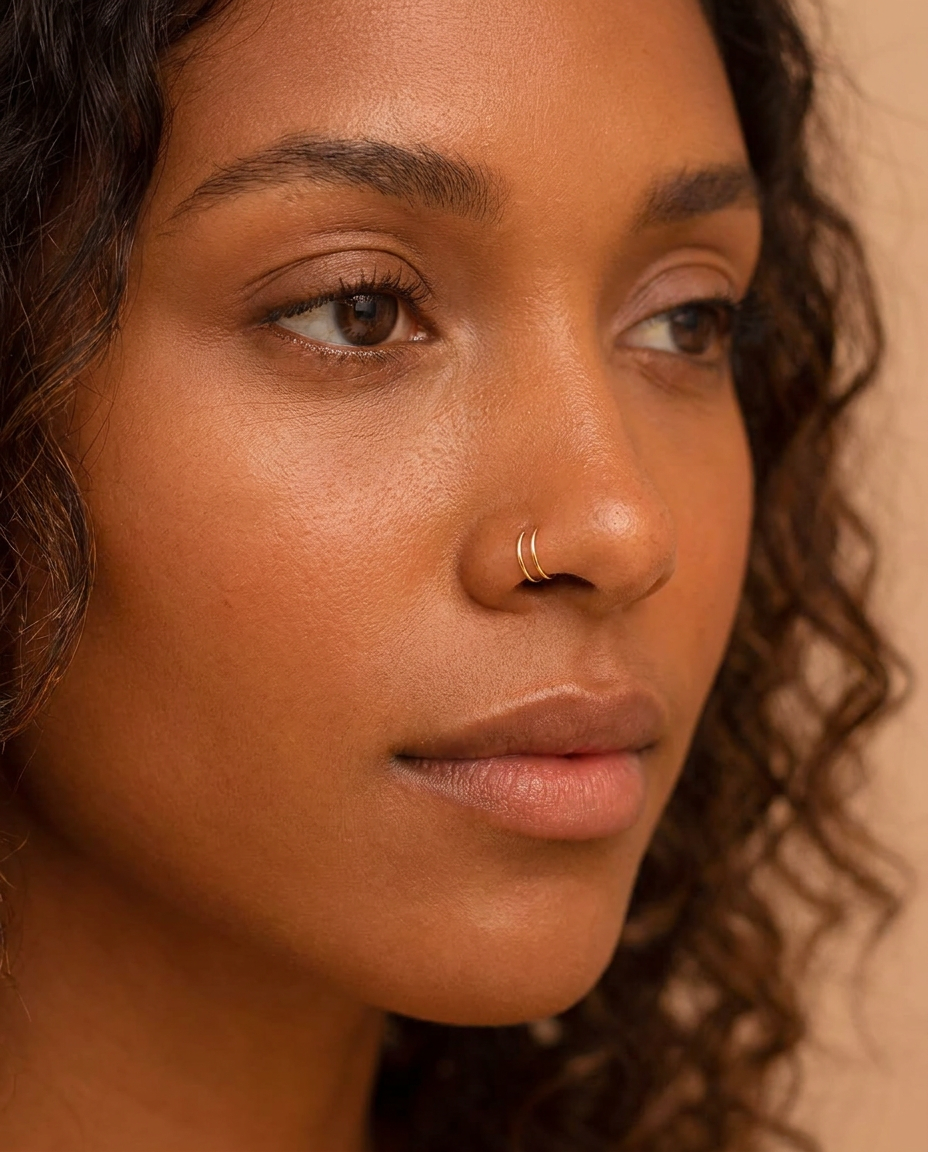
The short answer
Your current comfortable hoop is usually the best first reference
Double nose ring sizes describe the inner diameter. The most useful choice depends largely on the distance from the piercing channel to the lower nostril edge—not whether a nose looks generally small or large.
If an 8mm 20G single hoop already sits comfortably, an 8mm 20G double ring offers a sensible first comparison. The second visible line changes the style, not the way inner diameter is labelled.
Five sizes at a glance
From extra close to deliberately relaxed
These descriptions are visual and fitting references rather than guarantees. Nostril anatomy and piercing placement can vary.

| Size | General appearance | May suit | Useful check |
|---|---|---|---|
| 6mm | Extra close | Very low placement | A current 6mm hoop already fits without pressing |
| 7mm | Snug | Low placement | You want a close fit with slightly more room than 6mm |
| 8mm | Balanced | Many standard placements | Your current 8mm hoop feels comfortable |
| 9mm | Relaxed | Higher placement | You prefer more visible space beneath the nostril |
| 10mm | Statement | High placement or loose styling | Your current 9mm still feels close |
The close-fit comparison
6mm vs 7mm: how close should the ring sit?
One millimetre may sound small, but on a tiny nostril hoop it can noticeably change clearance and drop.
Extra-close fit
6mm may suit a piercing positioned very close to the lower nostril edge, especially when a current 6mm hoop already fits comfortably.
Snug, with a little more room
7mm may give a low placement enough extra clearance for both visible lines while retaining a neat, close-fitting silhouette.

The most useful comparison
7mm vs 8mm: snug or balanced?
7mm generally sits closer to the nostril. It may suit a lower placement or someone who already knows that 7mm feels comfortable.
8mm gives more breathing room and may allow the two visible lines to read more clearly. It is a useful reference for many placements, but it is not a universal standard.
More visible space
8mm, 9mm or 10mm?
As diameter increases, the hoop generally leaves more space beneath the nostril and creates a more noticeable drop.
Balanced
May suit many standard placements when a defined double line is wanted without an intentionally loose result.
Relaxed
May suit a higher placement or someone who prefers more visible space beneath the nostril.
Statement
Worth considering for a high placement, a deliberately loose silhouette or when 9mm still feels close.
A common checkout question
Do you need to size up because it is a double ring?
Not automatically.
The second visible line changes the appearance, while the inner-diameter measurement still works in the same way. A larger diameter may be worth considering when the current hoop already feels tight—not simply because the new design looks fuller.
Read the complete Double Nose Ring Buying Guide →Choose from evidence
What does your current hoop tell you?
The same inner diameter and gauge may offer the most sensible starting point.
A 1mm larger diameter may be worth comparing after checking that the piercing is fully healed.
A 1mm smaller diameter may be worth comparing if it would still clear the nostril comfortably.
Check the original order, measure carefully or ask a piercer before choosing a made-to-order ring.
Before checkout
Five size choices that can mislead you
Copying a model’s size
The same diameter can sit differently when placement and nostril shape change.
Choosing tiny at any cost
A smaller appearance is not useful when the ring presses, pulls or hides one of the visible lines.
Automatically sizing up
Two visible lines do not automatically require a larger labelled diameter.
Guessing diameter and gauge
Changing two specifications at once makes an uncomfortable result harder to understand.
Using a healing piercing
This comparison and product are intended for fully healed nostril piercings.
From comparison to product
Know your likely starting size?
Choose the diameter that reflects your placement or existing fit, then confirm gauge, gold colour and left- or right-nostril direction on the product page.
- 6mm–10mm inner diameter
- 18G or 20G
- Yellow, white or rose 14ct gold
- Handmade to order
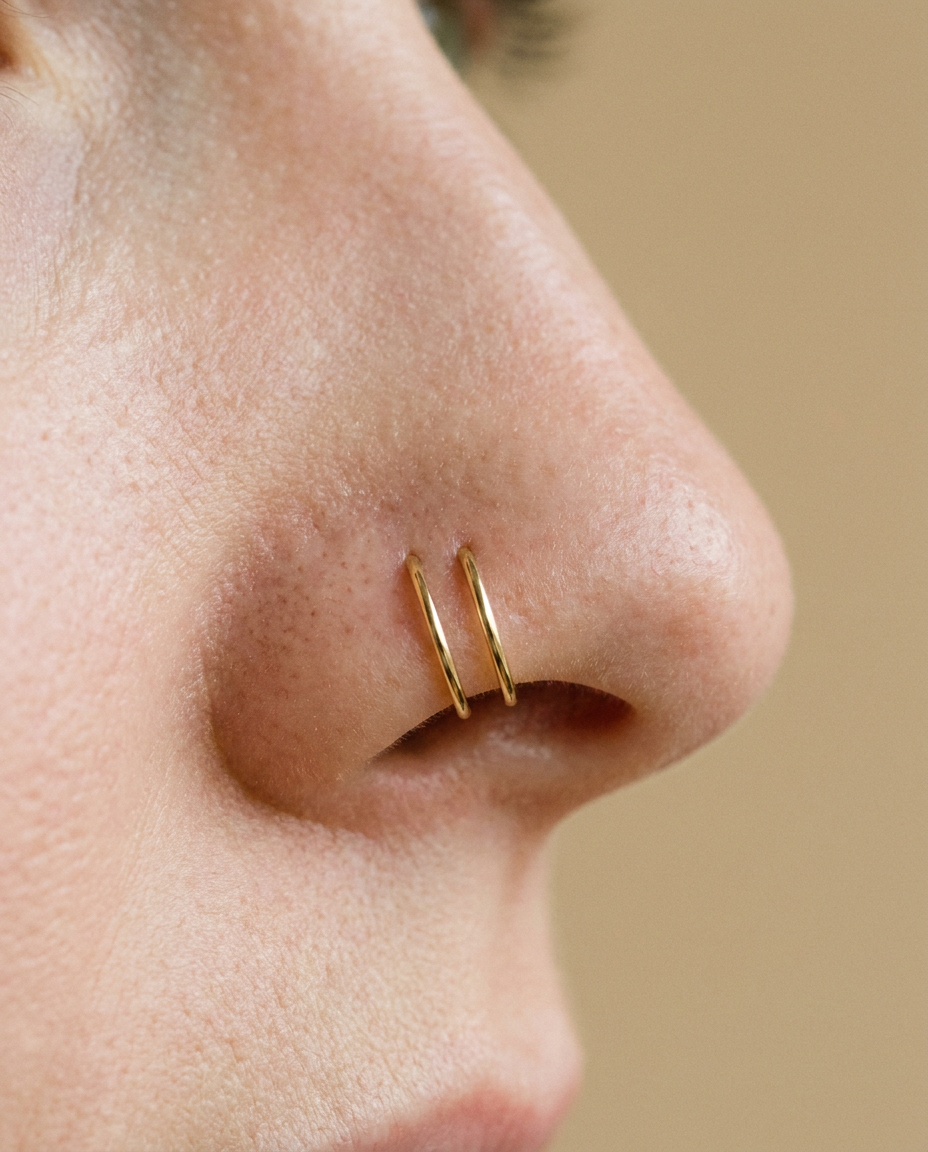
Double Nose Ring
£48.00
Two visible hoop lines, designed for one fully healed nostril piercing.
Choose my specifications Prefer one clean line? View the single nose hoop →Questions before ordering
Double nose ring size FAQ
Is 8mm the standard double nose ring size?
8mm may suit many placements, although it is not universal. Existing fit and piercing-to-edge distance are usually more useful references than popularity.
Should I size up for a double nose ring?
Not automatically. A larger size may be worth considering when your current hoop already feels too close—not simply because the new ring has two visible lines.
Is 6mm too small for a nose ring?
It may be suitable for a genuinely low placement when a current 6mm hoop already fits comfortably. It may be too close for standard or higher placements.
What is the difference between a 7mm and 8mm nose ring?
7mm generally sits closer. 8mm provides around 1mm more inner-diameter space and may create a more balanced or relaxed fit.
Does a double ring fit differently from a single hoop?
The connected shape changes the visual result, but inner diameter and gauge are still labelled in the same way.
Is diameter the same as gauge?
No. Diameter is the internal size of the hoop, while gauge is wire thickness.