


Complete size and buying guide
Double Nose Ring Size & Buying Guide
What it is, how one ring creates two visible hoops, how it differs from a single hoop or two separate piercings, and how to choose the right diameter, gauge and direction for a healed nostril.

Quick definition
What is a double nose ring?
A connected double nose ring is one shaped piece of jewellery that passes through a single fully healed nostril piercing and creates the appearance of two closely spaced hoops. The fit is usually chosen by inner diameter, gauge and left- or right-nostril direction.
- Piercings required
- One fully healed nostril piercing
- Visible effect
- Two coordinated hoop lines
- Available sizing
- 6–10mm inner diameter; 18G or 20G
- STEPOY material
- 14ct solid gold, also described as 14K gold
The STEPOY connected double ring
What you would be choosing
This guide relates to one directional, connected piece of jewellery that creates two visible hoop lines through one fully healed nostril piercing.
It is handmade to the specification selected at checkout. Confirming the diameter, gauge and pierced side before ordering may therefore be more useful than choosing from appearance alone.
Check the current price and options- Design
- One connected double hoop
- Piercing
- One fully healed nostril
- Inner diameter
- 6mm, 7mm, 8mm, 9mm or 10mm
- Gauge
- 18G / 1.0mm or 20G / 0.8mm
- Material
- Nickel-free 14ct solid gold
- Gold colour
- Yellow, white or rose gold
- Direction
- Your own left or right nostril
- Production
- Handmade to order in 3–5 working days
First: is this the look you want?
What a double nose ring actually changes
A single hoop creates one fine line around the nostril. A double nose ring creates two closely spaced lines from one piece of jewellery, so it reads more like a styled stack without asking you to add a second piercing.
That makes it useful when a plain hoop feels too minimal but a charm or gem is not your style. It gives more presence from the front and side, while keeping the same clean, unadorned gold finish. The trade-off is that the fuller design makes poor sizing more obvious: a ring that is too tight can pull the two lines into the tissue, while one that is too large can sit unevenly or hang lower than expected.
More visual impact
Two gold lines create a finished look even when the rest of your jewellery is minimal.
No second piercing
The connected design passes through one healed nostril piercing.
Made for your fit
The diameter and gauge that have already worked for your placement may offer the most useful starting point.
Clear up the name first
“Double nose ring” can mean three different things
Search results and social posts often use the same phrase for very different setups. Before comparing sizes or prices, check which version the jewellery actually is.
THE STEPOY DESIGN
One connected ring through one piercing
A single shaped piece passes through one healed nostril channel and creates two parallel lines outside the nose.
- One piercing required
- One piece to fit and align
- Left- and right-side versions matter
A DIFFERENT SETUP
Two separate hoops through two piercings
Two independent nostril piercings are placed close together, with one hoop in each. Each piercing can have its own size and angle.
A LOOK TO AVOID GUESSING
Two loose rings placed through one hole
This is not the same as a purpose-shaped connected ring. Crowding two unrelated hoops into one channel can change pressure and alignment.
One piece, two visible lines
How the connected design works
The ring is shaped so that one part travels through the piercing channel while the rest follows around the nostril, creating a second parallel line. You are not forcing two full wires through the same channel.
This is why direction matters. A ring shaped for the left nostril has to follow the opposite path from one shaped for the right. When the correct version is fitted and aligned, the two visible lines would usually appear as a deliberate pair rather than crossing, separating or pointing in different directions.
One wearable section
The part that passes through the healed channel would generally need to match your existing gauge.
One shared diameter
The inner diameter has the strongest influence on how the whole double-ring silhouette clears the nostril edge.
One directional shape
The connected curve has to correspond with your own left or right nostril.

Choose the setup—not just the style
Double ring, single hoop or two nostril piercings?
| Option | Piercings required | Visual effect | Best for | Main decision |
|---|---|---|---|---|
| Connected double ring | One healed nostril piercing | Two coordinated hoop lines | A stacked look without a second piercing | Diameter, gauge and direction |
| Single seamless hoop | One healed nostril piercing | One minimal gold line | The lightest, simplest appearance | Diameter and gauge |
| Two separate hoops | Two separately healed piercings | A custom two-ring stack | Independent placement and styling | Fit for each piercing |

The most useful shortcut
Already own a hoop that fits?
Start with the same inner diameter and gauge. If your current 8mm 20G single hoop sits comfortably, an 8mm 20G double ring is the most sensible first comparison. The extra visible line changes the style, not the measurement system.
There is usually no need to order a larger size simply because there are two visible hoops. A larger diameter may be worth considering when the current ring already feels tight, pulls upward or leaves a pressure mark.
Know your current size?
Go straight to the product Choose diameter · gauge · colour · side Choose my specificationsDiameter decides the fit
6mm, 7mm, 8mm, 9mm or 10mm?
These measurements are the inner diameter of the ring. Your best size depends mainly on the distance between the piercing channel and the lower edge of the nostril—not whether your nose looks small or large.

EXTRA-CLOSE FIT
Generally suited to a genuinely low placement
6mm may suit a piercing that sits very close to the lower nostril edge, particularly when a current 6mm hoop already fits without pressing. It creates the smallest visible gap and the most compact double-line effect.
It may be better not to choose 6mm purely for a tiny appearance. On a standard or higher placement, it could pull upward, indent the skin or make the two hoops sit unevenly.
SNUG FIT
Close to the nostril, with a little more room
7mm often suits low placements that need slightly more space than 6mm. The result is neat and fitted, with both lines clearly visible from the side.
Use 7mm as a reference if your current 7mm single hoop is comfortable. If your existing 7mm already leaves a mark or feels difficult to rotate, do not repeat that size just to keep a snug appearance.
BALANCED FIT
Visible double lines without an intentionally loose look
8mm gives more breathing room than 6–7mm and may work well for many standard nostril placements. It is a useful starting reference—not a universal size.
It may be a suitable choice if you already wear an 8mm hoop comfortably, or if your measurement suggests that a smaller ring would sit too close to the tissue.
RELAXED FIT
For a higher placement or more visible space
9mm allows the double ring to sit lower and creates a more obvious outline beneath the nostril. It may suit a piercing positioned farther from the edge or someone who dislikes a close hugger fit.
On a low placement, the same size may look deliberately loose. Compare it with a current ring rather than choosing from the model’s nose shape.
STATEMENT FIT
For high placements or a clearly looser silhouette
10mm creates the most visible drop in this range. It is best considered when your piercing is high, your current 9mm is still too close, or you specifically want a larger double-hoop look.
For an average or low placement it can hang noticeably below the nostril and move more during wear, so measure before ordering.
Use evidence, not a model photo
Choose from your current fit
The same inner diameter and gauge may offer the most sensible starting choice.
A 1mm larger option may be worth considering, after checking that the issue is diameter rather than irritation or an unhealed piercing.
A 1mm smaller option may be worth considering if the reduced diameter would still clear the nostril edge comfortably.
It may help to check the original order, ask your piercer or measure before buying a made-to-order ring.
Diameter decided?
Once the diameter is clear, the next choice is gauge.
Gauge is wire thickness
18G or 20G is not a style guess
A sensible starting point is usually the gauge already worn in your healed nostril. Moving from a finer post to a thicker ring may stretch the channel, while a finer wire can feel different even when the diameter stays the same.

18G
Visually bolder and slightly more substantial. 18G may be suitable when your healed piercing already wears 18G or your piercer has confirmed that the channel suits it.
20G
Finer and more delicate. 20G may be suitable when that is the gauge you already wear and you would like the double lines to remain refined.
The final product option
Choose your own left or right nostril
The connected double-ring structure is directional. Choose Left when the piercing is on your own left nostril and Right when it is on your own right nostril.
It may be safer not to copy the side shown in a product image, as selfies and edited photographs can be mirrored. Facing a mirror and checking the pierced side of your own nose may help before selecting an option.

Why this product is 14ct solid gold
Why solid gold may suit the double-hoop look
With two visible lines, the finish is a large part of the design. STEPOY’s double nose ring is made from 14ct solid gold—also described as 14K gold—not a gold-coloured coating over a different base metal.
Solid throughout
There is no plated outer layer designed to create the gold colour.
Made to your specification
The ring is handmade in the diameter, gauge, colour and direction selected at checkout.
For long-term style
A considered option for a fully healed piercing when you want an everyday double-hoop look.
Nickel-free alloy
Designed for customers seeking nickel-free solid-gold piercing jewellery, although individual sensitivities can vary.

What a comfortable fit may look like
Two clear lines, without pulling into the skin
A well-chosen double ring would usually follow the nostril with enough clearance for both lines to remain visible. A deep pressure mark, downward pull or one line disappearing into the tissue may suggest that the fit is too close.
A deliberately relaxed fit may leave more space below the nostril while still sitting in a stable direction. If the lines cross or separate unexpectedly, it may be worth checking the side selection and alignment before assuming the diameter is wrong.
Fitting and handling
It may help to treat it as one connected piece
A connected double ring follows one continuous path. The correct handling depends on the shape of the opening, so use the product instructions supplied with the ring rather than pulling the two visible loops apart.
Confirm the side first
A left-direction ring is unlikely to follow the same path as a right-direction ring.
Guide the ring gently
If the jewellery does not follow the healed channel comfortably, it may be better to stop rather than apply more pressure.
Rotate the connected shape
Follow the ring’s curve so the second visible line moves into position with the first.
Ask a piercer if needed
Professional fitting is the better option when you cannot see the channel or feel resistance.
Living with a solid-gold double ring
Everyday wear and simple care
The extra visible line does not require a complicated routine, but the connected shape benefits from an occasional alignment and cleanliness check.
Rinse away residue
During normal washing, rinse away skincare, makeup and soap residue around the jewellery, then dry gently.
Check the two lines
After sleep, changing clothes or snagging a towel, confirm that the ring has not rotated out of its intended position.
Keep harsh chemicals away
It may be best to avoid bleach, abrasive metal polish or aggressive cleaning products around the piercing channel.
Respond to persistent discomfort
If redness, swelling or tenderness persists, remove the guesswork and seek advice from a qualified piercer or healthcare professional.
A useful honest check
Is this double nose ring right for you?
IT MAY SUIT YOU IF
- Your nostril piercing is fully healed
- You want two hoops without a second piercing
- You know—or can confirm—your diameter and gauge
- You prefer plain solid gold to charms or stones
- You are happy to select the correct left or right direction
WAIT BEFORE ORDERING IF
- Your nostril piercing is fresh, sore or still healing
- You do not know which gauge you currently wear
- You are choosing a tight size only because it looks small
- You want two separate rings through two separate piercings
- You have not confirmed which directional option you need
A final two-minute check
Before opening the product page
If each answer below is reasonably clear, the product page should feel like a short specification check rather than another sizing lesson.
Diameter
I know the inner diameter that currently fits, or I have measured the piercing-to-edge distance.
Review diameterDirection
I am selecting my own left or right nostril rather than copying a mirrored photograph.
Review directionProduct terms
I understand that the ring is handmade to the selected specification and intended for a fully healed piercing.
View current product details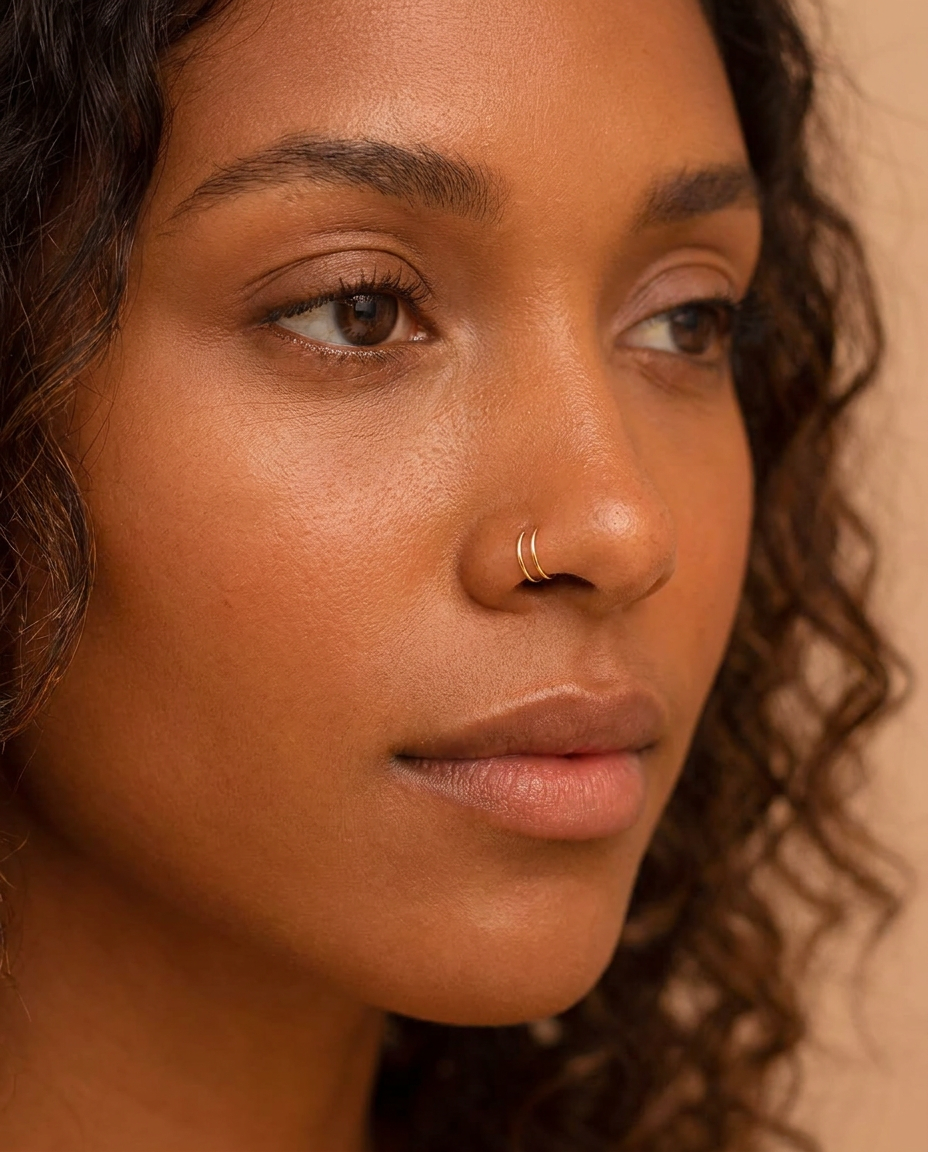
Ready when all four answers are clear
Build your double nose ring
Select the combination that matches your healed piercing—not the combination worn by a model.
- 1Diameter 6mm to 10mm
- 2Gauge 18G or 20G
- 3Gold colour Choose your preferred finish
- 4Direction Your own left or right nostril
Questions before checkout
Double nose ring sizing FAQ
Does a double nose ring require two piercings?
This connected design is intended to pass through one fully healed nostril piercing while creating two visible hoop lines.
Should I order the same size as my single nose hoop?
If your current hoop is comfortable, its inner diameter and gauge are the strongest starting reference. The double design changes the look, not the way diameter is labelled.
Is 8mm the standard double nose ring size?
8mm may suit many standard placements, although it is not universal. A lower placement may be better suited to 6–7mm, while a higher placement may be better suited to 9–10mm. Your existing fit or measurement is likely to be more useful than a popular size.
Should I size up for a double nose ring?
Not automatically. Size up when your current hoop is already too tight or your measured placement needs more clearance—not simply because the new ring has two visible lines.
How do I know whether I wear 18G or 20G?
It may help to check the order details for your current jewellery or ask your piercer. 18G is 1.0mm thick and 20G is 0.8mm; that difference can be difficult to judge reliably from a photograph.
How do I choose the left or right option?
The directional option should correspond with the pierced side of your own nose. It may be safer not to rely on a mirrored selfie or the apparent side worn by a model.
Can I use this ring in a healing nostril piercing?
This product and guide are intended for fully healed nostril piercings. For a fresh or healing piercing, it would be sensible to follow your piercer’s advice and keep appropriate healing jewellery in place.