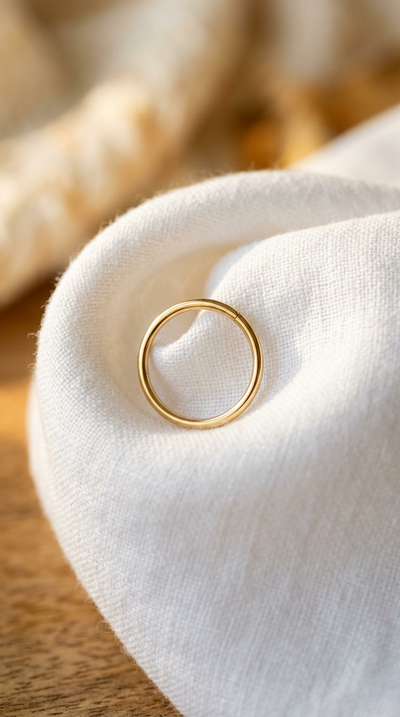
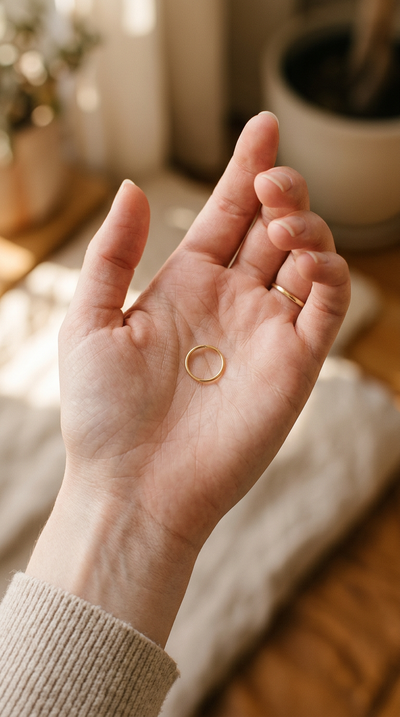
New 14ct Solid Gold Piercing Hoop


Second & Third Lobe Piercing: Placement, Pain & Jewellery

- A second lobe piercing sits 8–10mm above the first — close enough to form a visual pair, far enough to accommodate two earrings without crowding
- A third lobe sits 7–9mm above the second — spacing tightens slightly as the lobe narrows towards the cartilage
- Pain is the same as your first lobe — a brief pinch lasting 1–2 seconds. No worse, no better.
- Healing is 6–8 weeks per hole, identical to a first lobe — but a third hole at the top of the lobe may take 8–10 weeks as tissue firms
- Get both ears done at the same time, but do second and third holes one at a time so you always have a comfortable sleeping side
- Always go to a needle piercer, not a gun — precision matters more with multiple holes because spacing errors are permanent
Where exactly they go
Placement is the single most important decision for second and third lobe piercings. Unlike a first lobe — which goes roughly in the centre of the earlobe — additional holes have to be placed in relation to existing piercings, and the spacing must account for the jewellery you plan to wear. Get this wrong and the piercings will either look too close together (earrings overlapping) or too far apart (the gap looks empty rather than curated).
Second lobe placement
The second lobe piercing sits directly above the first, following the natural curve of the earlobe. Standard spacing is 8–10mm centre-to-centre (measuring from the centre of the first hole to the centre of the second). This distance allows two standard studs (5–6mm diameter) to sit side by side with a clear gap between them, or a stud and a small huggie hoop without the hoop resting on the first earring.
Some people prefer tighter spacing (7mm) for a deliberately clustered look, while others go wider (11–12mm) to leave room for larger earrings. Both are valid, but the further you deviate from 8–10mm, the more you are committing to a specific jewellery style. 8–10mm is the most versatile range — it works with studs, hoops, huggies and dangles.
Third lobe placement
The third lobe piercing sits above the second, continuing the vertical line up the earlobe. Standard spacing is 7–9mm from second to third. The spacing is slightly tighter than between first and second because the lobe narrows as it rises, and equal spacing at the wider bottom gap would look disproportionately wide at the top.
The third hole sits at the very top of the soft earlobe, close to where the tissue transitions from soft lobe to firmer pre-cartilage. On some ears, this position is still clearly soft tissue. On others, it is right at the boundary. Your piercer will feel the tissue before piercing and adjust the exact position to stay within soft tissue — even 2mm into pre-cartilage changes the healing time from 8 weeks to 4–6 months.
| Position | Spacing from previous | Tissue type | Healing time |
|---|---|---|---|
| 1st lobe | Centre of earlobe | Soft tissue | 6–8 weeks |
| 2nd lobe | 8–10mm above 1st STANDARD | Soft tissue | 6–8 weeks |
| 3rd lobe | 7–9mm above 2nd | Soft to firm transition | 6–10 weeks |
How much it hurts
A second lobe piercing hurts the same as a first lobe piercing: a brief, sharp pinch that lasts 1–2 seconds, followed by a mild warmth and throbbing that fades within an hour. On a 1–10 pain scale, most people rate it 2–3 out of 10.
The third lobe is slightly more uncomfortable for some people — typically 3–4 out of 10 — because the tissue at the top of the lobe is firmer and has more nerve endings than the fatty centre. The pain is still brief and manageable, but people who had a painless first lobe sometimes notice the third is a small step up.
| Piercing | Pain (1–10) | Duration | Description |
|---|---|---|---|
| 1st lobe | 2–3 | 1–2 seconds | Brief pinch in soft, fatty tissue |
| 2nd lobe | 2–3 | 1–2 seconds | Same tissue, same sensation |
| 3rd lobe | 3–4 | 1–2 seconds | Firmer tissue, slightly sharper pinch. Still brief. |
| Helix (for comparison) | 4–5 | 1–2 seconds | Cartilage crunch — noticeably different from lobe |
One at a time or all at once?
This is the most common question for people planning multiple lobe piercings. The answer depends on what you are getting done:
Both ears, same position: do them together
If you want a second lobe on both ears, get both done in the same session. They are the same healing difficulty, the aftercare is the same, and doing both at once means one healing period rather than two. You can still sleep on your back or use a travel pillow for the first 2 weeks.
Second and third on the same ear: do them one at a time
Getting a second and third on the same ear simultaneously means two healing wounds in close proximity. The discharge from one runs onto the jewellery of the other, the swelling compounds, and the aftercare is fiddly. More importantly, if one bump or complication develops, it is harder to identify which piercing is the problem. Get the second, heal it (6–8 weeks), then get the third.
The sleep problem
The real constraint is sleeping. If you get a second and third on the right ear at the same time, you cannot sleep on the right side for 2 weeks and both piercings take 6–8 weeks to heal. If you then do the left ear, you cannot sleep on that side either. By spacing piercings out — one new hole every 8 weeks — you always have a comfortable sleeping side.
Healing differences
The healing process for a second lobe is identical to a first lobe: 6–8 weeks, saline twice a day, do not touch or twist. The aftercare does not change because additional holes are in the same tissue type. For the full week-by-week breakdown, see our lobe piercing healing guide.
The third lobe has one notable difference: it sits at the top of the lobe where tissue is firmer and transitions towards pre-cartilage. This means:
Slightly longer healing. 8–10 weeks rather than 6–8, depending on how close to the cartilage boundary the piercing sits.
Marginally higher bump risk. Firmer tissue is less forgiving of pressure and movement. The risk is still much lower than any cartilage piercing, but higher than a standard lobe.
More sensitivity to sleeping pressure. The top of the lobe is the point of the ear that contacts the pillow first when side-sleeping. A third lobe piercing at this position is more exposed to pillow pressure than a first or second lobe. Avoid sleeping on that side for the first 3 weeks (rather than the 2 weeks recommended for a first lobe).
Jewellery for a lobe stack
A curated lobe stack is one of the most popular jewellery trends in 2025 — multiple coordinated earrings running up the earlobe that look deliberately assembled rather than randomly accumulated. Here is how to build one that works.
The classic three-piece stack
1st lobe: statement piece. This is the anchor. A slightly larger stud (6–8mm), a small drop earring, or a huggie hoop. This earring sets the tone for the stack.
2nd lobe: accent piece. Smaller than the first. A 4–5mm stud, a tiny bezel-set gem, or a micro huggie hoop. It supports the first earring without competing.
3rd lobe: minimal piece. The smallest in the stack. A 2–3mm flat-back stud, a tiny ball, or a minimalist bar. This finishes the line and creates an ascending or descending gradient.
Design rules that work
Match the metal. All pieces in 14K yellow gold, or all in white gold, or all in rose gold. Mixing metals across a lobe stack looks unintentional unless you are very deliberate about it.
Graduate the size. Largest at the bottom, smallest at the top. This follows the natural taper of the lobe and creates visual flow. Placing the largest earring at the top looks heavy and top-weighted.
Mix styles, not metals. A stud + huggie hoop + flat-back in the same metal colour creates variety with cohesion. Three identical studs looks uniform but boring. Three completely different styles in different metals looks like three separate piercings rather than a curated set.
Gauge and earring compatibility
Lobe piercings are typically done at 20G (0.8mm) or 18G (1.0mm). This is thinner than cartilage piercings (which are usually 16G) because the lobe is soft tissue and does not need the structural support of a thicker post.
Most fashion earrings — the kind you buy at a jewellery shop — are made for standard lobe piercings and will fit. However, there is no industry-wide standard for fashion earring post thickness, and some cheap earrings use very thin pins (0.6mm) that wobble in a properly-gauged lobe hole. For a clean, secure fit across your stack, use earrings with posts in 20G or 18G from a piercing jewellery brand rather than a fashion brand.
Cost in the UK
A second or third lobe piercing at a professional studio in the UK typically costs £20–£35 per hole, including basic implant-grade titanium or surgical steel jewellery. If you want to be pierced with 14K gold jewellery, expect to pay an additional £15–£40 per earring depending on the style. Many studios offer a discount for multiple piercings in the same session.
Compared to gun piercing (£10–£25 per pair, jewellery included), needle piercing costs more per hole but delivers cleaner channels, better jewellery, and faster healing. The total cost difference for a pair of second lobes is typically £10–£20 — a small price for precision and hygiene.
Common mistakes
Getting all three lobes at once on the same ear. Two healing wounds 8mm apart interfere with each other. Space them out — heal the second, then get the third.
Using a gun for the second or third. Placement precision is critical when holes need to be evenly spaced. Guns cannot be aimed to the millimetre. Needles can.
Choosing your "forever earrings" before healing. Heal on flat-back studs. Assemble the final stack after healing. Decorative earrings during healing catch, move and cause bumps.
Spacing too tight for the jewellery you want. If you plan to wear huggie hoops (which are 10–12mm in diameter), spacing of 8mm between holes means the hoops overlap. Tell your piercer what jewellery styles you plan to wear — they will adjust the spacing accordingly.
Ignoring the cartilage boundary on the third hole. If the piercer does not check tissue firmness before placing the third, the hole may end up in pre-cartilage — which heals like a cartilage piercing (months, not weeks). A good piercer always pinches the lobe at the proposed position to confirm the tissue is still soft.
Matching the other ear exactly. Ears are not symmetrical. Trying to place the second lobe at exactly the same height on both ears, measured from the bottom of the lobe, often results in piercings that look off because the lobes themselves are different shapes. A good piercer matches by visual balance, not ruler measurement.