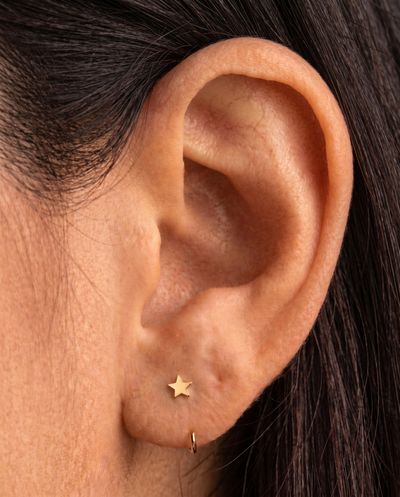
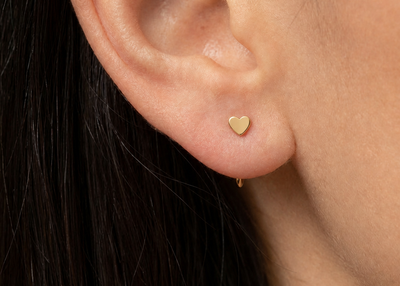
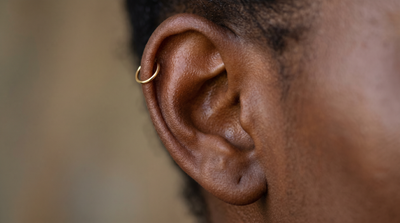
New 14ct Solid Gold Piercing Hoop


Cross 14ct Solid Gold Conch Ring
Cross 14ct Solid Gold Conch Ring


Where to Buy Authentic 14K Solid Gold Seamless Hoops Online
- The word “gold” alone means nothing. Only “14K solid gold”, “585 gold”, or “14ct gold” guarantees the ring is gold all the way through
- Red flags: no karat stamp mentioned, price under £15 for a hoop, vague material descriptions like “gold tone” or “gold colour”
- Trusted sellers will disclose the exact alloy composition (e.g. palladium-silver-copper, nickel-free) and provide a hallmark or certificate
- Specialist body jewellery brands are almost always more reliable than general fashion jewellery marketplaces for piercing-grade gold
- UK buyers: look for the UK hallmark (anchor for Birmingham, leopard for London) — it is a legal guarantee of gold content
Decoding gold terminology in product listings
The single biggest problem when shopping for gold hoops online is misleading terminology. Sellers use words like “gold”, “golden”, and “gold finish” interchangeably, but they mean very different things. Here is what each term actually means:
| Term | What it actually is | Gold content | Safe for piercings? |
|---|---|---|---|
| 14K Solid Gold / 585 Gold | Gold alloy throughout — no base metal core | 58.3% pure gold | Yes — APP-approved |
| Gold-Filled (14/20 GF) | Thick gold layer mechanically bonded to brass | 5% gold by weight | No — base metal exposed over time |
| Gold Vermeil | Thick gold plating over sterling silver | <1% gold | No — plating wears off |
| Gold Plated | Thin electroplated gold over brass/steel | <0.05% gold | No — wears off in days to weeks |
| Gold Tone / Gold Colour | No gold whatsoever — just the colour | 0% | No |
| Gold PVD Coating | Vacuum-deposited gold-coloured layer on steel | 0% gold | No |
Red flags when shopping for 14K gold hoops online
1. No specific karat stamp mentioned
A genuine 14K solid gold seller will always specify “14K solid gold”, “585 gold”, or “14ct solid gold” in the product title or description. If the listing just says “gold earring” or “gold hoop” without the karat designation, the product is almost certainly not solid gold.
2. No alloy composition disclosed
Trustworthy sellers of solid gold body jewellery will tell you exactly what is in the alloy — typically “palladium-silver-copper, nickel-free” or similar. If the seller cannot or will not disclose the alloy, there is a good chance the product contains nickel or is not solid gold at all.
3. Unrealistically low price
As of 2026, the spot price of gold makes it impossible to produce a genuine 14K solid gold seamless hoop for less than approximately £20–25 (for a small 20G, 6mm ring). Any “14K gold” hoop priced below this threshold should be treated with extreme scepticism.
4. Stock photos instead of real product images
Reputable jewellery brands show their actual products — often on models, with close-up detail shots. If the listing uses generic studio photos that appear on dozens of different sellers’ listings, the product is likely mass-produced plated jewellery resold under different brand names.
5. No return policy or guarantee
Sellers who stand behind their gold quality offer returns, exchanges, and often a certificate of authenticity or hallmark guarantee. No-return policies on “gold” jewellery should raise immediate concerns.
How to verify authenticity after purchase
Check for a karat stamp
Use a magnifying glass or jeweller’s loupe to look for “14K”, “585”, or “14ct” stamped on the ring. On very small seamless hoops, the stamp may be tiny or absent due to limited surface area — in that case, rely on the seller’s documentation.
Look for a UK hallmark
In the UK, gold sold as a specific carat must be hallmarked by an assay office. Look for the anchor (Birmingham), leopard (London), rose (Sheffield), or castle (Edinburgh) stamp alongside the karat mark. This is a legal guarantee of gold content.
Visit a local jeweller for testing
Any high-street jeweller can perform a quick acid test (costs a few pounds) or XRF analysis (non-destructive) to verify whether a ring is genuine 14K gold. This is the definitive way to confirm authenticity if you have any doubts.
The skin test (over time)
Wear the ring for a week. Genuine 14K solid gold will never cause green discolouration, tarnishing, or skin reactions. If you notice any colour change on the ring or your skin within a few weeks, the product is not solid gold.
Where to shop for authentic 14K gold seamless hoops
Specialist body jewellery brands (best option)
Brands that specialise exclusively in body piercing jewellery are the most reliable source for genuine 14K solid gold seamless hoops. These companies understand gauge sizing, inner diameter measurement, alloy safety, and piercing-specific requirements. They typically disclose full material specifications and use body-safe, nickel-free alloys. Look for brands that explicitly reference APP material standards.
Professional piercing studios
Many professional piercers sell high-quality jewellery directly. The advantage is that they can fit the jewellery for you, confirm your gauge and diameter, and ensure the ring is appropriate for your piercing. The downside is typically a smaller selection and slightly higher prices due to the in-person service.
Fine jewellery brands with piercing lines
Several established fine jewellery brands have launched dedicated piercing collections in recent years. These typically use recycled 14K gold and offer hallmarked pieces. The quality is excellent but prices tend to be higher than specialist body jewellery brands, reflecting the fashion brand premium.
Your pre-purchase checklist
Before clicking “buy” on any 14K gold seamless hoop, confirm all of the following:
| Check | What to look for | Red flag if missing |
|---|---|---|
| Material | “14K solid gold” or “585 gold” explicitly stated | Just says “gold” without karat |
| Alloy | Nickel-free alloy composition disclosed | No alloy information available |
| Price | £25+ for a small hoop, £35+ for larger | Under £15 for “14K gold” |
| Sizing | Inner diameter specified, gauge clearly stated | Only “small/medium/large” sizing |
| Hallmark | UK hallmark or karat stamp mentioned | No mention of any stamp or certification |
| Returns | Clear return/exchange policy | No returns or “final sale” on jewellery |
| Photos | Original product photos, ideally on a model | Stock photos used by multiple sellers |