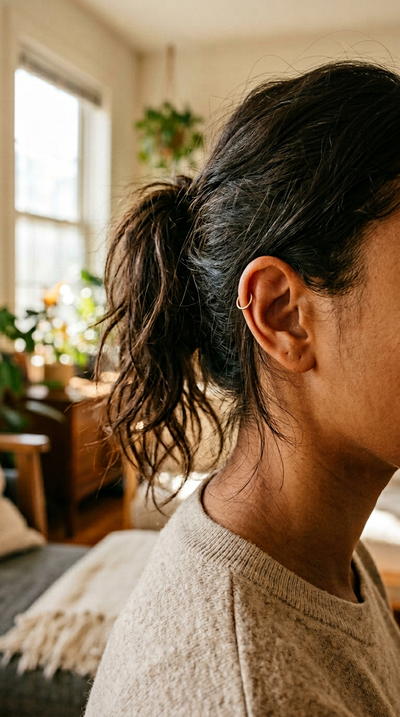
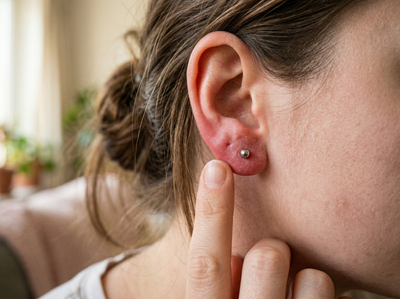
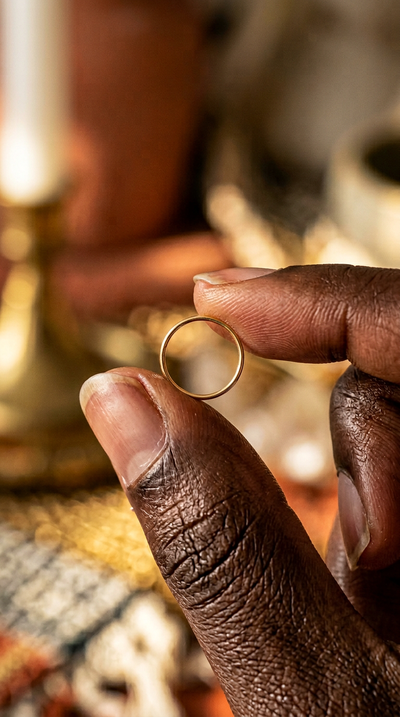
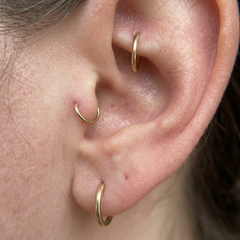
New 14ct solid gold hoop


Cartilage Piercing Jewellery: Earrings, Hoops & Studs
- Cartilage piercings use three main jewellery types: seamless hoops, flat-back studs, and clickers
- Size varies dramatically by location: 4mm for forward helix up to 12mm for outer conch
- 14K solid gold and implant-grade titanium are the only safe metals for long-term cartilage wear
- Always start with healing jewellery (studs/barbells), then switch to hoops once fully healed
- Half sizes (6.5mm, 7.5mm) make the difference between a good fit and a perfect fit
Cartilage jewellery types
Seamless hoop
A continuous ring with no visible join. The most popular post-healing option for every cartilage piercing. Creates a clean, minimal look. Available from 4mm (forward helix) to 12mm (outer conch). The seamless design means no clasp or hinge to catch on hair or clothing.
Flat-back labret stud
The standard healing jewellery for helix, tragus, and conch piercings. A decorative front (ball, gem, or disc) with a flat disc on the back. The flat back sits flush against the skin, preventing snagging and providing stability during healing.
Curved barbell
The standard healing jewellery for rook and daith piercings. A gently curved bar with decorative ends on both sides. The curve follows the natural shape of inner ear folds.
Clicker ring
A hinged ring that clicks shut securely. Easier to insert and remove than seamless hoops. Popular for daith piercings where access is difficult. Available in plain and ornate designs.
Size by piercing location
| Piercing | Hoop Size | Gauge | Notes |
|---|---|---|---|
| Forward helix | 4-6mm | 18G/20G | Smallest sizes. Half sizes essential. |
| Standard helix | 7-8mm Popular | 18G | Most versatile range. |
| Hidden helix | 6mm | 18G/20G | Snug to rim for discretion. |
| Tragus | 6-7mm | 18G | Small, low-profile. |
| Rook | 6-8mm | 16G/18G | Nestled in antihelix fold. |
| Daith | 7-8mm Popular | 16G/18G | Hearts and clickers popular. |
| Inner conch | 8-9mm | 16G/18G | Wraps the inner edge. |
| Outer conch | 10-12mm | 16G/18G | Statement wrap around ear. |
Metal guide
Cartilage piercings heal slowly (3-18 months depending on location). Your body is in contact with the jewellery material throughout this entire period. Metal quality is not optional — it is critical.
| Metal | Verdict | Notes |
|---|---|---|
| 14K solid gold | Excellent | Biocompatible, no tarnish, no nickel. Best for healed piercings. |
| Titanium (ASTM F136) | Excellent | Lightest, completely nickel-free. Best for initial healing. |
| 18K solid gold | Good | Softer than 14K, scratches more easily. Beautiful colour. |
| Surgical steel (316L) | Caution | Contains nickel. Risky for the 10-15% with nickel sensitivity. |
| Gold-plated | Avoid | Plating flakes off inside the channel. Never for cartilage. |
| Sterling silver | Avoid | Tarnishes inside the piercing. Can cause permanent staining. |
Gauge explained
Gauge is the thickness of the wire or post. For cartilage piercings:
16G (1.2mm): standard for rook, daith, conch, and some helix piercings.
18G (1.0mm): most common for helix and tragus. Slightly finer than 16G.
20G (0.8mm): thinnest common option. Popular for forward helix and delicate styles.
Important: always match your jewellery gauge to your piercing gauge. Wearing a thinner gauge can cause the channel to shrink. Wearing a thicker gauge forces the channel and causes pain.
Healing vs healed jewellery
During healing: flat-back studs (helix, tragus, conch) or curved barbells (rook, daith). These provide stability, accommodate swelling, and minimise movement in the channel.
Once healed: seamless hoops, clickers, or decorative pieces. The channel is mature enough to handle movement and different jewellery shapes.
The transition: your piercer should perform the first jewellery change. They can assess whether the channel is truly ready and ensure the new piece is inserted cleanly.